

Kassioun Editorial 1274: The Success of the April 17th Protest is a Turning Point!
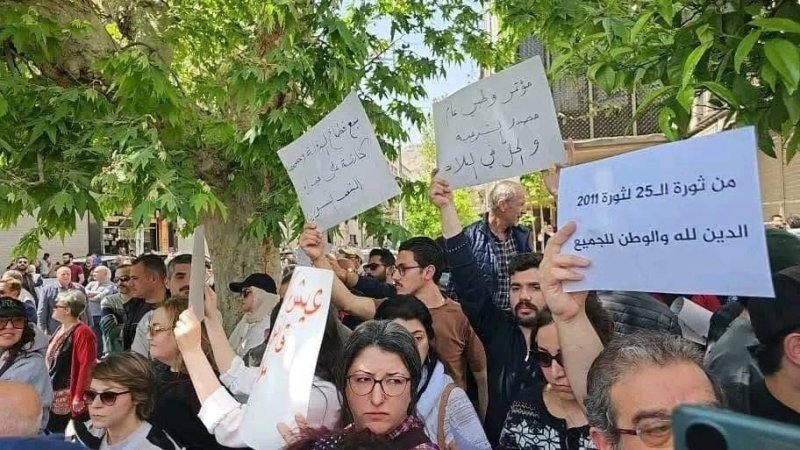
The protest, which all the forces of the old past and its ghosts—both abroad and at home—tried to exploit and divert from its demands on the one hand, or intimidate and frighten on the other, has succeeded in overcoming all these obstacles, marking a turning point in modern Syrian history.
This is a milestone upon which more can be built, and it will provide a positive momentum for the struggles of Syrians, which are increasingly expressing themselves—primarily through their socioeconomic demands that affect the lives of 95% of Syrians: the impoverished and dispossessed who live below the poverty line. These people constitute the only real majority in Syria, spanning all ethnicities, religions, sects, and intellectual and political orientations.
The most prominent feature of this protest is that—despite all attempts at distortion and intimidation—it managed to focus on two main directions in its written demands, chants, and conduct. The first direction is a socioeconomic, demand-driven direction that stands against economic liberalization measures, including the lifting of subsidies and price increases, the bias toward investors’ interests over those of the general public, and the trend toward privatizing sovereign state sectors. It also opposes corruption, favoritism and nepotism, and violations of people’s rights, property, and livelihoods.
The second direction is the clear national character of the protesters, reflected in numerous signs opposing foreign intervention—especially “Israeli” roles—and in the repeatedly chanted slogan: “Syria is free, free—Israel, get out!”
The combination of these two directions—the socioeconomic demands directly affecting 95% of Syrians and the explicit rejection of foreign intervention—is one that can genuinely unite the Syrian people. It helps prevent their division into conflicting camps based on distorted political grounds or on sectarian, religious, or ethnic lines. This combination serves as an antidote to opportunists, both inside and outside the country.
Among the clear conclusions drawn by protestors on the ground is the vast gap between the “generals” beyond the seas and behind the screens, and the reality on the ground. The loudest voices online, which directly or indirectly pushed for escalation and maximalist slogans, were almost entirely absent in reality and failed to steer people in the directions they desired. In contrast, the actual protestors succeeded in imposing rational and disciplined behavior.
This represents a critically important first step in the path of the popular movement—which is now entering a new phase—toward generating its own leadership from within and preventing any attempts to hijack it. It is also a first step for the genuine forces that participated directly, presenting themselves to the people as equals rather than as leaders, and offering their programs and tangible conduct to earn public recognition. Only then can they play their true role in representing the people.
It should also be noted that the general security forces played a positive role on the ground in protecting the protestors and preventing attacks against them. This is a new development in modern Syrian history that should be reinforced and strengthened, while addressing its shortcomings, including the immediate and strict accountability of those who incite division, incitement, and accusations of treason.
In conclusion, the success of the April 17 protest reflects the level of boiling discontent in the Syrian street, which has manifested through a series of socioeconomic protests in recent weeks. It also shows that people have learned from past experiences and have begun organizing themselves in a more effective, rational, and responsible manner toward their country and fellow citizens. This process of organization will continue to develop and advance day by day, ultimately achieving Syrians’ fundamental goals: building a free, united, and dignified homeland for all its people, with a political system that truly represents their interests and steadfastly defends them.