

Kassioun Editorial 1273: Regarding the Slogan “We Want to Eat… We Want to Live!”
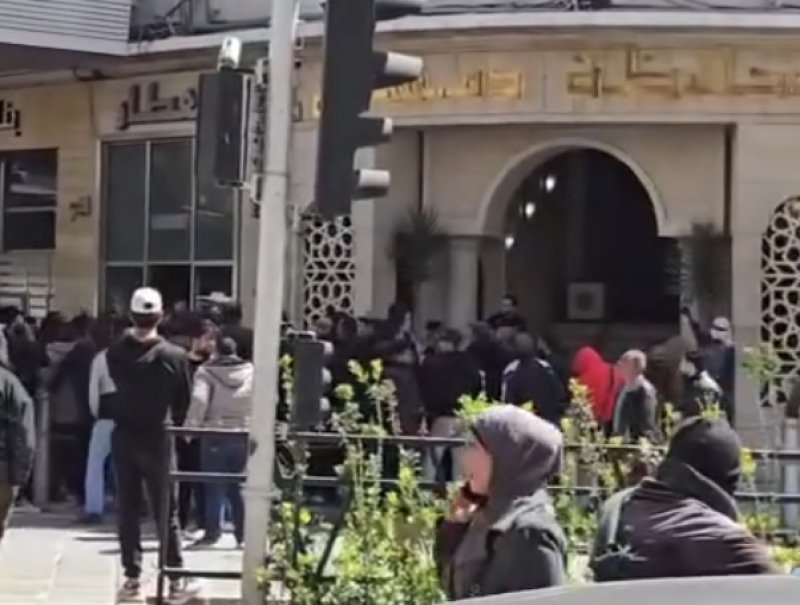
Recent weeks have revealed a gradual rise in socioeconomic protest movements carried out by Syrians across various parts of the country and in many economic sectors: from teachers to taxi drivers and street vendors, as well as the struggles of residents of the Jobar and Qaboun neighborhoods to preserve their rights and property. These also include protests against increased taxation rates, rising service prices, and the lifting of subsidies—especially for electricity and telecommunications—along with threats of privatizing the healthcare sector, and the grievances of dismissed employees or those still working but facing wage deductions or repeated delays in receiving their salaries.
The expansion of these socioeconomic struggles, both horizontally and vertically, is natural and expected given the catastrophic socioeconomic conditions experienced by the vast majority of Syrians. This is not only due to emerging regional developments, but also—more fundamentally—to the economic policies being implemented, which in essence represent a continuation of former policies that favor a very small minority of profit earners (no more than 5% of Syrians, spanning all ethnicities, religions, and sects), at the expense of the Syrian people—namely wage earners, who make up 95% of the population and likewise come from all ethnic, religious, and sectarian backgrounds.
The development of these socioeconomic struggles is not only expected and natural, but also positive. It contributes directly to uniting Syrians around their real interests, beyond narrow identities that serve only profit earners, warlords, and hostile external forces, foremost among them “Israel”.
Therefore, it is the duty of Syrian patriots—regardless of their positions or ideological and political orientations—to work to protect and support these struggles, and to pave the way for them to develop naturally toward unifying the Syrian people on the basis of their real interests.
Within this context, these socioeconomic struggles must be protected from clear threats:
First: They must be protected from attempts to divide and fragment them along sectarian, religious, or ethnic lines—in other words, from efforts to pit the suffering majority (the 95%) against one another. They must also be shielded from attempts to push them into pre-manufactured, destructive binaries such as “regime vs. opposition”, “secular vs. religious”, or “majority vs. minorities”, and so on. What unites the suffering people of this country is that they constitute the overwhelming majority—practically all the people—living below the poverty line, witnessing firsthand the extravagance of a small minority from all sides, inside and outside the country. This reality should be what unites these socioeconomic struggles, and through them, unites the Syrian people and truly unites Syria.
Second: They must be protected from attempts to derail them, primarily through artificially imposing leadership over them and without consultation. Although things are still in their early stages, there are indications of attempts by forces and figures outside the country to appoint themselves as leaders of the people, to ride these struggles and steer them in directions completely contrary to the interests of the people and the country. In practical terms, this means that people—who have learned from bitter experience—must further organize themselves and create and choose their own leadership. At the same time, political forces, which remain largely disconnected from the pulse of the people, must engage in these struggles, offer what they have learned from their experience to the people, seek their approval to participate in representing them, and abandon the mindset of the “general” who dictates to the masses from above—deciding when they should struggle, where, and what slogans they should raise.
The rising socioeconomic mobilization of the Syrian people should be treated by all Syrian patriots, regardless of their positions, as a positive sign—a herald of a new phase in the Syrian popular movement to complete the realization of the people’s goals after the fall of Assad’s rule: building a new system that is economically and socially just, free, democratic, unified, and sovereign—one in which the dignity of the nation and the dignity of the citizen are equally safeguarded.