

Kassioun Editorial 1306: Floating the Syrian Pound… Floating Responsibility for its Collapse
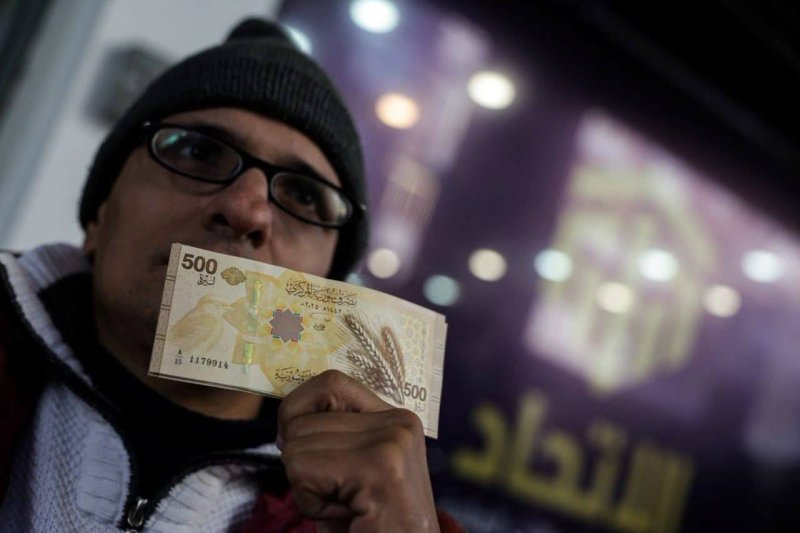
Over the past week, news has “leaked” to local media about meetings held by the Central Bank of Syria with representatives of the UN, international organizations, and non-governmental organizations to discuss scenarios for “addressing the gap” between the official exchange rate of the Syrian pound and its market rate. Floating the pound was among the leading options under consideration. Although the matter has not yet become an official decision, merely putting it on the table under the current socioeconomic conditions raises extremely serious questions about the direction of the country’s economic policy and about who will bear the consequences of these policies.
Currency floating, in brief, means that the state and central bank abandon the practice of setting a fixed exchange rate for the national currency, leaving its value to be determined by what are known as “market forces of supply and demand”. However, what does this seemingly innocent and neutral economic phrase conceal? Under a fixed exchange-rate system, the state is the entity that sets the official rate and bears responsibility for defending it. Under a floating exchange-rate system, control shifts to the market. The key question is: Who actually controls this market?
In the Syrian case, everyone understands that we are not talking about a “natural” market in which supposedly equal actors compete on a level playing field. Rather, we are dealing with a market in which major monopolists, speculators, and those who wield power and possess enormous wealth have an exceptional ability to influence currency movements. Those who possess millions of dollars can withhold them from circulation to drive up their price; those who control imports can increase demand for dollars; and those with massive capital can speculate on the pound and profit from its fluctuations. Thus, “supply and demand forces” are not mysterious forces operating on their own; behind them stand interests, influential actors, and wealth owners.
Nor can this direction be separated from its broader economic context, including the repeated visits to Damascus by IMF and World Bank missions, and the expanding involvement of both institutions in “discussing” monetary, fiscal, and budgetary policies. The direction of the policies being proposed brings to mind the familiar economic formulas whose costs have been borne by peoples around the world in the form of price increases, cuts in government subsidies, a diminished social role for the state, and the burden of these economic policies being imposed solely on wage earners and the world’s poor.
If this course continues, it will mean nothing but a further deterioration in Syrians’ living standards, rising prices of goods and services, and the erosion of the real value of wages—accumulating the conditions for a new social explosion whose full consequences no one can predict.
Floating the currency may be understandable in an economy that has a consistently favorable trade balance, a strong productive base, and well-established exports that ensure continuous inflows of foreign currency. However, in Syria, where production has been devastated, importinghas been opened up without restriction, and the national economy has been drained to the extreme, floating the pound would, in practice, mean leaving people at the mercy of “market forces”, without any real protection against their fluctuations.
More alarming still, moving toward a floating exchange rate, if confirmed, reflects an implicit admission by those making economic decisions that the pound has reached an extremely weak position, and that the prospects for rescuing it—within the existing economic model—have become nonexistent. Instead of reviewing the policies that brought it to this state, they are searching for a mechanism that shifts responsibility for its deterioration from those in power and making the decisions onto the “market” and its fluctuations, as though currency depreciation were a natural fate unrelated to economic policy.
The real alternative to floating the currency is to fundamentally address the causes of the collapse in the pound’s strength, foremost among them weak production, the trade imbalance, speculation, and the concentration of wealth. What is needed is to move toward an economic policy that protects production, labor, and wages, and restores the state’s role in safeguarding the public interest.
The Syrian pound is one of the symbols of national sovereignty and a cornerstone of national security, whose foundation and essence are economic security. Squandering the ability to protect it and handing its fate over to those who wield the greatest control over the market is a decision that threatens the country’s present and future.