

Kassioun Editorial 1265: The American Waves the Stick, and the Solution is Internal and Syrian
Over the past few days, a number of significant US moves concerning the Syrian situation have taken place. These moves are naturally linked to Syria’s internal dynamics, but even more so to the broader, rapidly evolving regional developments—including major contradictions within the American and Western elite regarding war on Iran: between continued military mobilization on one hand, and negotiations and talk of a possible agreement on the other, which has even reached the point of announcing the possibility of a meeting between Trump and Khamenei.
The most prominent moves are the following:
First: On 12 February, the US Central Command announced the completion of the withdrawal of its forces from the al-Tanf base toward Jordan and its handover to the Syrian authorities, after nearly 10 years of presence there.
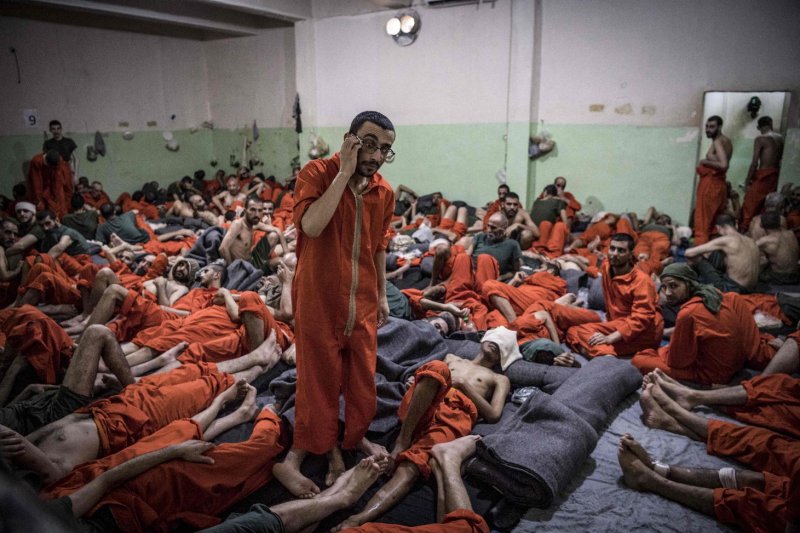
Second: Also on 12 February, it was announced that the transfer of about 5,700 ISIS prisoners from northeastern Syria to Iraqi prisons had been completed, so they could be tried there under Iraqi law. What is striking and raises questions is that around 3,000 of them—more than half—are Syrians, at the very same time that Iraq had demanded foreign states take back ISIS prisoners holding those states’ nationalities.
Third: A hearing was held before the US Congress Foreign Relations Committee on 10 February titled: “Syria at a Crossroads: Challenges for US Policy After the Fall of the Assad Regime”. The session included sharp criticism of the new Syrian authorities, especially regarding their treatment of minorities, and carried an escalatory tone with threats of reimposing sanctions.
Although the abovementioned moves may appear completely contradictory—between what could be understood as support for and confidence in the new authorities in Syria, and what could be understood as the exact opposite, namely a threat to and action against those authorities. The reality is that they represent a division of roles within a single US policy, which cannot be understood from the narrow angle of attitudes toward the authorities in Syria, but from the broader perspective of regional conflict and the wider international struggle.
The most important points to note in trying to understand these moves are the following:
First: American talk of “protecting minorities” is, as usual, a lie and does not truly aim to protect minorities. It is entirely similar to the talk during the Caesar Act period about “protecting Syrian civilians”, the outcome of which was always more and more Syrian civilian victims. What must be understood in this context is that talk of “protecting minorities” and threats of renewed sanctions have absolutely nothing to do with protecting any Syrian, but with specific American interests.
Second: More clearly, the Americans are waving the stick of sanctions and minorities not in defense of minorities, but because there are policies they dislike and that do not align with their interests—chief among them: first, that the new authorities in Syria have not yet offered the required official and public concessions toward “Israel”. In truth, any authority in Syria is incapable of offering the demanded concessions, because the regional situation – the five-party alliance – prevents it on one hand, and because it would collapse domestically if it did so on the other. Second, the nature of the relations the new authorities are trying to shape at the regional and international levels, including their relationship with Russia, which will of course not please the Americans.
Third: Vacating al-Tanf and transferring Syrian ISIS prisoners to Iraq implicitly means reopening the door to the re-emergence of ISIS—strongly—as a tool in American hands against all parties in Syria and in the region.
The Way Out
The only way out for the country and its people from the explosions being prepared by the Americans and the Zionists lies in the following:
First: Resolving the violations and rights dossiers internally through immediate and public accountability.
Second: Achieving genuine integration of the entire Syrian society through real participation, and its gateway is a general national conference that is inclusive and comprehensive of all Syrian political and social forces.
Third: Leaning on the Syrian people and relying on their unity by doing them justice and by concretely granting them the right to determine their own destiny.
Fourth: Immediately halting the implementation of the IMF and the World Bank formulas in the economy—those savage neoliberal formulas that dismantle the social role of the state, entrench poverty and unemployment, and push the country and its people toward larger and more dangerous explosions.