

Kassioun Editorial 1300: The Second Global Wave Has Only Just Begun!
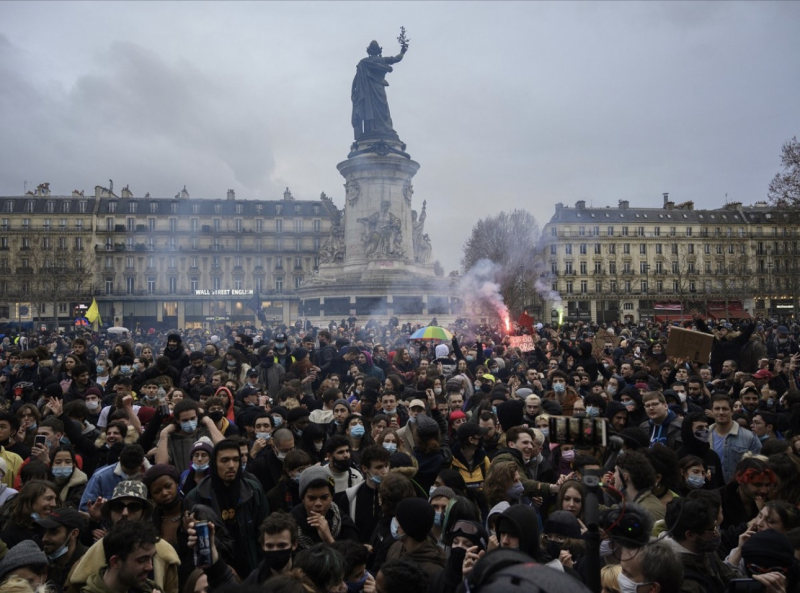
According to the organizers, 800,000 people took part in the demonstrations in France on Saturday, 17 October, while the French Interior Ministry put the figure at 550,000. This was the 31st day since the protests began. Initially led by students, the movement has expanded to encompass ever-wider sections of French society, including teachers, students’ parents, the Yellow Vests movement, workers, trade unions, and employees across various sectors.
At the same time, over the past two weeks, the protest movement has spread to Belgium, Albania, Italy, and Portugal. There are clear indications that the protests could extend to every country on the European continent. Meanwhile, a parallel wave of “No Kings” protests has emerged in the US in recent days and is also expected to grow.
The deterioration of conditions in French schools—in terms of services, teacher numbers, and other factors—served as the spark that ignited the mass movement. However, its underlying causes extend far beyond the education sector. They affect various sectors not only in France, but throughout the West and indeed across the entire world. These causes can be summarized as follows:
First: Beginning in the 1980s, with the adoption of the so-called “neoliberalism”, a systematic process began across Europe to roll back the social role of the state and reduce social spending, taking advantage of the already evident decline of the Soviet Union. The process then accelerated following USSR’s collapse, as the working class was left without an alternative model. It accelerated further at the beginning of the current century, before entering a new phase of sharp acceleration with the war in Ukraine and the increase in “defense spending” at the expense of social expenditure.
Second: In parallel, neoliberalism was forcibly imposed on many “Third World” countries under various labels, including “free-market economy”, “social market economy”, “structural reform”, and so on. This further weakened these states and pushed them toward widespread social explosions, as has been happening since 2010, in what may be described as the first wave of global popular mobilization.
Anyone who believes that what is happening in Europe today, or in the US, concerns the West alone is mistaken. At its core, what is unfolding is an expression of the historical expiration of the entire existing global order: a predatory form of capitalism that concentrates power and wealth in the hands of a tiny minority of billionaires, at the expense of the blood, hunger, and suffering of billions of people throughout the world.
By the same token, anyone who believes that the “Arab Spring” has come to an irreversible end is mistaken. What has happened so far is merely the first wave. The second wave is approaching, and it will encompass everyone. It will be more aware and better organized than the first. What history has taught us over the past 250 years is that when popular movements take to the streets as a result of the accumulation of unresolved problems, they do not return to complete passivity until a major transformation has been achieved across the entire system. Throughout their active phase, which may span decades, these movements advance and recede in successive waves. Yet their overall trajectory is one of continued ascent: greater momentum, stronger organization, and deeper awareness, until their objectives are achieved. At their core, these objectives amount to comprehensive, radical change.
The equation we must understand is this: protecting the popular movement that represents those who have been dispossessed, and helping it organize its ranks around its shared socioeconomic, patriotic, and democratic interests—while steering clear of destructive divisions along sectarian, ethnic, or religious lines—is the shortest and safest path for both peoples and states alike.
This applies to our own country, Syria, just as much as it applies to others—and even more so.