

Kassioun Editorial 1295: Fuel Price Hikes Are New Fuel for Social Explosion
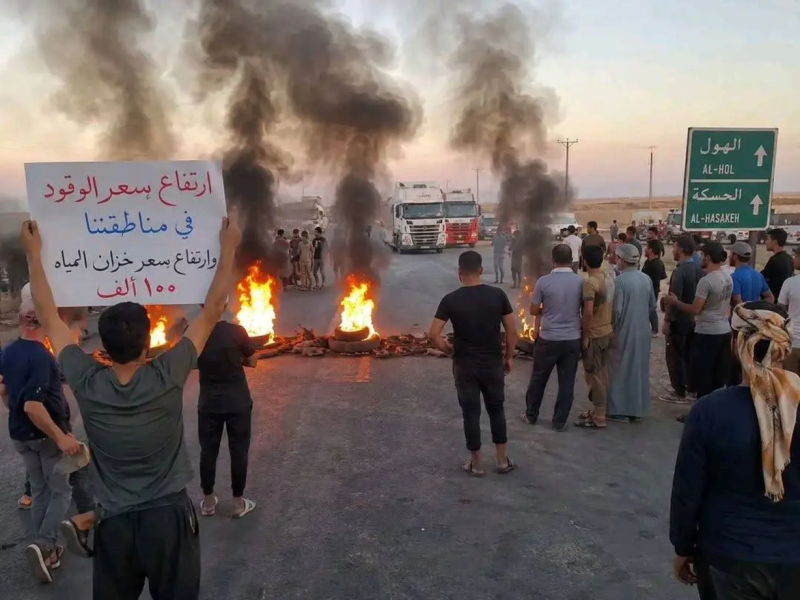
Mere hours after the government raised fuel prices by rates reaching approximately 40%, the effects of the decision began to appear immediately in the markets—including a rise in prices of goods and services, an increase in the dollar exchange rate in the parallel market, and protests and road blockages in several areas. The government justified its decision by citing the global rise in oil and energy prices due to the regional war and closure of the Strait of Hormuz, as well as Syria’s need to finance the import of roughly two-thirds of its oil requirements.
According to the data available during the same period in which the government made this decision, the average increase in global oil prices did not exceed 9%. Meanwhile, neighboring countries—Turkey, Iraq, and Jordan—kept their fuel prices unchanged, while the increase in Lebanon was limited to an average of no more than 2.8%. So how can the outcome in Syria be an increase of up to 40%? What is the economic logic that justifies imposing on Syrian consumers an increase far greater than the global increase that is used to justify the decision?
The main problem lies in treating an increase in the global price as sufficient justification for raising the domestic price. This logic takes into account neither Syrians’ ability to absorb the increase, nor its impact on production, nor its repercussions on social stability. Fuel is not an ordinary commodity that can be treated solely according to market-price logic. Rather, it is a major input into every process of production, transportation, and distribution, and any increase in its price quickly spreads throughout the entire economy.
Thus begins a new cycle of inflation: fuel prices rise, driving up the costs of transportation, production, and services; the prices of goods then increase; purchasing power declines; raising wages becomes necessary; and the increased labor costs are then incorporated into the prices of goods and services, causing prices to rise once again.
Ultimately, people with fixed incomes find themselves facing an income whose real value is continuously shrinking, even if their nominal salary increases in Syrian pounds.
As for the government’s justification that this price is not fixed and that prices will rise and fall in accordance with fluctuations in global markets, this is even worse than the decision itself, because it raises an obvious question:
Why must the price of fuel produced or refined domestically necessarily be tied to global oil exchanges?
Is it not more logical for quantities designated for export to be sold at global prices, while quantities intended for domestic consumption are priced according to local production costs and the economy’s and society’s ability to bear them?
The global price is not a sacred economic law that must be imposed on every country in the same way. States formulate their energy policies according to their interests, productive capacity, and social circumstances. In some cases, the state may absorb part of the cost in order to protect the productive sectors and the consumers. If the state bears the difference between the cost of production or imports and the price paid by consumers in order to protect production, this should not be treated as a “loss” to the state. Rather, it should be understood as necessary expenditure to invest in production, preserve purchasing power, prevent inflation, and protect the economic cycle.
The policy of constantly chasing global price adjustments is doomed to fail from the outset, and it is a political choice that will have direct consequences for the distribution of wealth. The more these increases are imposed on the poorest segment of the country—which constitutes the overwhelming majority of Syrians—the more wealth becomes concentrated in the hands of those who can pass every increase on to poor Syrians, who alone will pay the price through their wages and standard of living.
The issue of fuel has always been, and remains, far greater than a matter of immediate financial calculations. It is a matter of national security and social stability that cannot be managed according to stock-market logic and its fluctuations, nor by passing on to society the consequences of every change in global markets. If the state wants to protect the economy and production, it must view fuel as part of an integrated socioeconomic policy. Otherwise, the country risks facing a new social explosion whose consequences no one can predict.