

Kassioun Editorial 1294: Stop Assad’s Legacy in the Expropriation Issue!
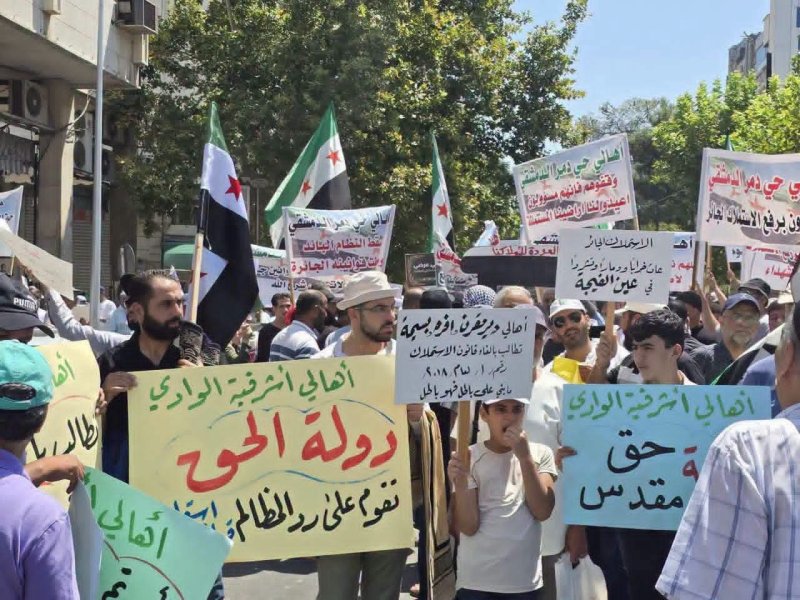
Popular protests against expropriations are no longer confined to one or two areas. They have recently begun to expand geographically, moving from scattered protests toward a broader state of organized popular opposition. More important than the expansion of their geographical reach is the fact that the protesters themselves have become better able to organize, coordinate, and unify their demands. The issue of expropriations, which successive authorities have attempted to treat as merely a set of “legal issues”, has once again revealed itself for what it truly is: a socioeconomic and political issue affecting the rights of hundreds of thousands of Syrians.
In principle, expropriation is a right granted by law to the state to take private property for the purpose of implementing a project that serves the public interest, in return for compensation to its owners. However, what happened in Syria is that expropriations were transformed into a means through which the state could seize citizens’ properties, while many projects remained suspended for years, or their purposes changed, leaving the owners of the expropriated properties with none of the public benefit that was supposed to justify depriving them of their property.
In the majority of cases, the lands and properties expropriated in Syria did not belong to powerful elites or wealthy individuals. Rather, they belonged to farmers, government employees, people with limited incomes, and families that had accumulated their properties over decades of work. As a result, a significant part of expropriation policies effectively became a redistribution of wealth from the poor to the rich. For this reason, expropriation was one of the factors that accumulated social discontent in Syria and, alongside plunder, impoverishment, corruption, and unemployment, contributed to the social explosion of 2011.
Continuing to deal with expropriations today with the same mindset that prevailed under Assad is something Syrians can no longer accept. There is no meaning in talking about a “break with the past” while unjust decisions remain in force, just as it is impossible to speak seriously of genuine transitional justice while thousands of Syrians remain deprived of their rights and property.
What is required today is a comprehensive review of every expropriation decision, one by one: examining whether the public purpose for which the expropriation was carried out was actually fulfilled, whether the compensation paid was fair, and what became of the land and properties taken from their owners. More importantly, the executive authorities today must not base their conduct on the laws and practices of the Assad regime simply because they remain formally in force.
The obvious question here is: Why is there expropriation in the first place if the state needs land to implement a specific project? Why not simply purchase the land directly from its owners at fair prices that reflect its true value? Would that not be fairer, and socially and politically less costly, than forcibly taking property and opening the door to disputes that could continue for decades to come?
Addressing the issue of expropriation must be part of a broader solution that also includes genuinely resolving the housing crisis—not in the way that real-estate development tycoons and the cronies of major property brokers are trying to convince Syrians that a cost of up to $1,200 per square meter is somehow normal in a country where more than 95% of the population lives in poverty.
The protests against expropriations today carry a meaning far broader than simply defending a piece of land or a home. They are a new expression of a truth we have repeatedly emphasized: when Syrians’ livelihoods, land, homes, and rights are at stake, they find themselves in the same trench, regardless of their regions, ethnicities, or sects. They are a reminder that the Syrian people are not a collection of “minorities” and a “majority” fighting one another on false foundations. Rather, the overwhelming majority are a dispossessed and exploited population confronting a minority that has accumulated wealth at their expense.
Taking the issue of expropriations seriously must begin with a comprehensive review thereof, restoring rights to their owners where possible, providing fair compensation where restoration is not possible, and developing an entirely new policy toward land, housing, and property. Insisting on governing the country based on the same unjust laws, the same executive mindset, and the same decisions that contributed to producing social discontent and the explosion will only result in reproducing the past in an even more devastating form.