

Kassioun Editorial 1280: Lessons from the Flood
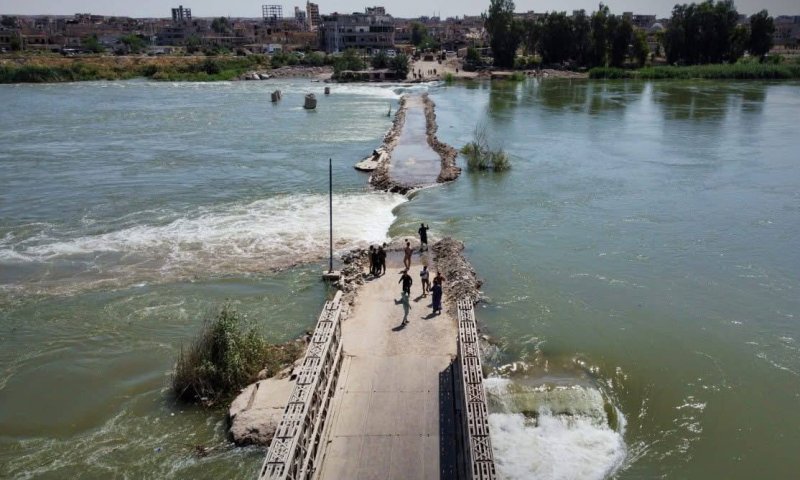
Among the lessons and conclusions drawn from the Euphrates River’s flooding — and its disastrous effects, which have not yet been fully uncovered — are the following:
First: The flood is a clear indicator and proof of the scale of accumulated neglect and marginalization over decades in northeastern Syria. This is despite the fact that the region has always been a primary source of the country’s wealth — oil, wheat, cotton, and more. Yet it has remained among the poorest, and most vulnerable and neglected areas in the country, to the point of severe underdevelopment in all sectors, especially economic, health, and educational development.
Second: This neglect has continued even after the fall of Assad’s authority; in fact, one could say it has gone further. This is evident in the withdrawal of support for agriculture in all its forms — fuel, seeds, fertilizers, pesticides, and more — as well as the neglect of the healthcare sector in all its branches. It is also reflected in the pricing of wheat, which after the announced “reward” covers the cost of rainfed cultivation, but is significantly lower than the costs of irrigated wheat cultivation (according to pre-2011 statistics, as no newer data is available, irrigated wheat cultivation accounts for 43% of the total wheat-growing area but produces around 70% of the country’s total wheat production, while rainfed cultivation covers 57% of the cultivated area and produces only about 30% of the total).
Third: Neglect and marginalization become far more severe when combined with weak technical and scientific competence in dealing with disasters. This weakness can turn a rainy season into a catastrophe, as has clearly happened. It also reveals the high price the country could pay as a result of adopting policies prioritizing political loyalty over technical expertise and professional competence, along with attempts to monopolize decision-making and control, excluding any real participation by the people. It also sidelines the vast reservoir of Syrian expertise both inside the country and abroad, expertise that continues to be systematically marginalized.
Fourth: One aspect of the flood disaster is Turkish policy toward the river – a policy that, for consecutive years, deprived the country of a significant portion of its water share under the pretext of political animosity. Subsequently, when the river overflowed, Turkey acted to avert the disaster within its own borders by diverting it southward. This situation reflects, on the one hand, the vulnerability that Syria has long suffered – and continues to suffer – in its relations with regional countries; and on the other, it underscores the imperative to transform this great river – which connects the countries of the region – into a shared lifeline: a life built upon cooperation, fraternity, and the convergence of interests among the countries of the entire Greater East, while fully upholding the sovereignty, independence, and self-determination of their respective peoples.
In addition to all the urgent solutions required – including negotiating with the Turkish side in an attempt to mitigate the scale of the looming catastrophe – the comprehensive solution has always been, and continues to be, in building a genuine state: one founded upon the true participation of the people, dedicated to serving their interests, and focused on establishing a productive industrial and agricultural economy – rather than an economy of flashiness, tourist spectacles, and political maneuvering.
The question of the required economic model for Syria is no longer just a question about economic direction, but an existential question for Syria today: Will our economy serve the 90% and more Syrians who are below the poverty line, or will it be an economy that serves those in official uniforms, the beneficiaries, and the influential?
The answer to this question is not purely economic, but its essence is political. The politics is ultimately a condensation of economy, and the economy that serves 90% of Syrians should be built on a policy in which these 90% participate in the making thereof. This means that the need for radical and comprehensive change is today an existential need to stop the slide towards the abyss, and to open the horizon towards rebuilding again.
The approach was and still is a comprehensive national unity government that includes the main political and social currents in the country, and benefits from their great experiences and competencies that are being excluded for narrow-minded political considerations. The approach is also a comprehensive general national conference with full powers through which Syrians decide their fate and the fate of their state themselves.