

Kassioun Editorial 1301: The Syrian Popular Movement Is Advancing… Who Will Engage It?
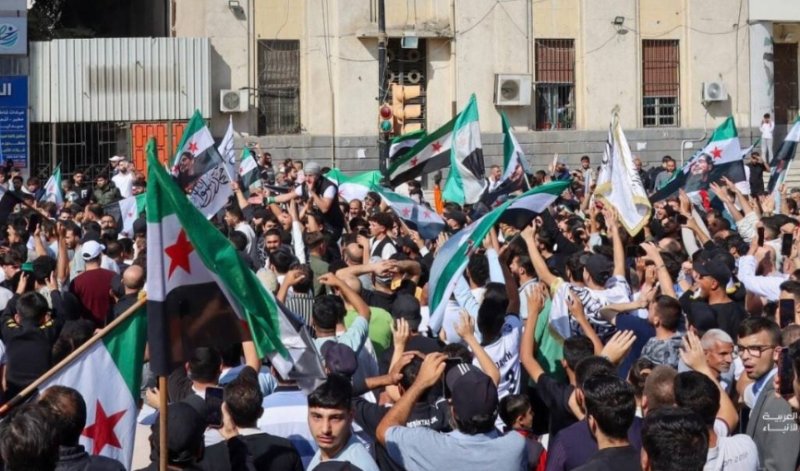
In Kassioun’s last editorial, against the backdrop of escalating protests in France, Belgium, Albania, Italy, Portugal, and the US, Kassioun noted that the spread of protest movements is not a passing phenomenon confined to Western countries. Rather, it reflects a deep crisis within the existing global order and the return of people to the streets to defend their rights and interests. It stressed that the “Arab Spring” is not over and that a second wave of popular mobilization is approaching. Drawing on the experiences and lessons of the first wave, this new wave will have greater awareness and be better organized.
Turning from the global scene—where popular mobilization intensified over the past week—to Syria, the most notable development over the past week has been the growing presence of protest movements and the widening range of their demands and forms. These have extended from demands concerning livelihoods and public services to objections against decisions affecting rights and property, and ultimately to protests against the blatant and escalating corruption of some Syrian officials. It is no small matter that rejecting corruption has become one of the principal drivers of popular anger, and that people are expressing it openly and louder than before.
At the heart of all this lies the question of livelihoods. The Syrian pound continues its rapid decline, while prices of goods and services, as well as transportation, housing, energy, and food costs, continue to rise. Wage earners find themselves increasingly unable, day after day, to meet their basic needs. When harsh living conditions converge with a sense of injustice, corruption, and the absence of fairness, protest becomes a natural expression of problems whose resolution can no longer be postponed or concealed behind statements and false promises.
Protests against a local administrative decision here, a property expropriation case there, or the deterioration of public services, cannot be separated from the country’s broader socioeconomic reality. These demands, although they may appear disparate, converge on a single question: Whose interests do state institutions serve—the 90% of Syrians living in poverty, or those who reap enormous profits?
Beyond its increasing loudness, what stands out about the Syrian popular movement today is its developing capacity for self-organization. At almost every protest site, local forms of communication and coordination are increasingly taking shape, along with efforts to define demands, choose ways of expressing them, and follow up on them. Protesters are learning from one another’s experiences and acquiring practical skills in transforming scattered individual objections into clearer, more organized collective action. This is a cumulative process that does not stop at a single demonstration, sit-in, or partial demand. Rather, it carries the potential to deepen awareness of the interests Syrians share, regardless of differences in their regions or secondary affiliations. The grassroots organization we see growing today, emerging from people’s everyday experiences and their confidence in their ability to defend their rights collectively, is poised to develop further than ever before.
Rising internal tensions are unfolding in a world where protests and contradictions are intensifying, and peoples of the world are mobilizing to defend their living standards and rights. It is unwise to view this as something that can be ignored, contained with temporary palliatives, or addressed by treating every popular movement as a local problem or a burden to be eliminated. Decision-makers must understand that the popular movement is not, in itself, a threat to the country. The real danger lies in allowing the causes of public anger to persist and in closing off avenues for a serious and meaningful response.
Against this backdrop, the responsibility today falls on all those of integrity, both within and outside the state apparatus, to engage with the popular movement and respond to it positively, rather than stand in its way or simply observe it. Such engagement requires bold and serious steps, beginning with genuinely listening to people’s demands, holding those involved in corruption accountable, reversing unjust decisions that have burdened Syrians and deepened their poverty, and opening the way for meaningful popular participation in determining policies that affect people’s lives.
At their core, the Syrians raising their voices today are demanding genuine social stability—stability founded on justice, rights, and dignity. The more their awareness and organizational capacity grow, the more necessary it becomes for the response to their demands to rise accordingly. Engaging with the popular movement today, rather than confronting it or imagining that it can be circumvented, is the safest path to protecting Syria and its future.