

Kassioun Editorial 1288: What is the significance of Guterres’s visit?
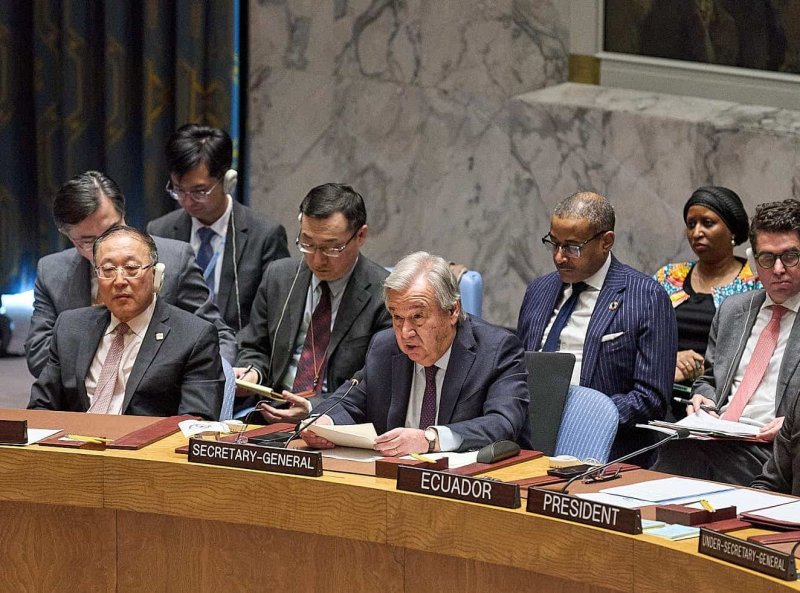
The visit by UN Secretary-General, António Guterres, to Syria, which began on Saturday, 25 July 2026, carries particular significance in terms of both its timing and its implications.
Naturally, the visit is not merely a protocol or publicity event. It is well known that the UN Secretary-General’s various activities require at least a minimum level of consensus among the five permanent members of the UN Security Council: the US, China, Russia, the UK, and France.
In this sense, the visit reflects a shared concern among the permanent members regarding the current situation in Syria and its possible future trajectories, including the serious risks arising from the accumulation of crises, even though significant disagreements remain over the direction that should be taken.
Implicitly, the visit also reflects the minimum common ground that exists regarding Syria, namely UNSC Resolution 2254, whose core principles concern a political solution, a political transition, and the support and monitoring of that transition.
The tangible reality in which this visit is taking place includes several clear elements:
First: The overwhelming majority of Syrians continue to face extremely difficult socioeconomic conditions, with most living below the poverty line, bringing with it risks of every kind.
Second: Western economic sanctions—particularly those imposed by the US—continue to play an important role in constraining any meaningful economic recovery, despite claims that they have been lifted.
Third: In parallel, there are negative external pressures exerted by the US, both politically and economically (including encouraging military intervention in Lebanon, among other issues), alongside the military pressures and attacks carried out by “Israel”.
Fourth: The security situation remains tense, with the likelihood of further deterioration increasing amid poor economic conditions and clear external efforts to fuel internal conflict along sectarian, religious, and ethnic lines, coupled with renewed roles being assigned to terrorist organizations such as “ISIS”.
Fifth: Economically, the prevailing policy direction continues to be one of neoliberalism, with all that entails in terms of dismantling the state’s social role and deepening poverty and marginalization.
Sixth: Politically, the situation continues to be characterized by attempts to monopolize power, while offering only a limited degree of superficial and non-genuine participation.
Finally: Developments over recent months indicate that the recurring tensions and crises moving from one region of the country to another—from the coast to Suwayda, and then to the northeast—are all connected to the general situation, even where each case appears to have its own specific causes. More worrying still is that any new hotspots (and there are now clear indications of growing risks in the northeast and east, including Deir ez-Zor) could reignite previous hotspots that have yet to fully recover.
The Political Solution and the Role of the United Nations
For many consecutive years, Bashar al-Assad rejected any genuine UN role in facilitating a resolution to the Syrian crisis. In practice, this was reflected in his implicit rejection of UNSC Resolution 2254, his refusal of the proposal (which we put forward during the Constitutional Committee’s first meetings) to move the Committee’s work to Damascus, and his rejection of opening UN offices and the UN’s Syria team in Damascus, insisting instead that they remain in Geneva.
Events have since demonstrated that rejecting a political solution only worsened the situation and imposed ever greater losses and sacrifices on the Syrian people.
Today, Syria still needs a comprehensive political solution whose essence lies in realizing the Syrian people’s right to self-determination through genuine participation. One of the key instruments for achieving this is a General National Conference, alongside a Government of National Unity that includes the country’s full spectrum of political and social currents.
There also remains a need for a facilitating role by the UN—one that reflects international consensus while using that consensus to prevent any external actor from imposing unilateral pressure on Syria. Whatever criticisms may be made of the UN, its facilitating role constitutes a fundamental safeguard for containing and mitigating the external pressures that any of the major powers outside the organization might otherwise exert.
In conclusion, Syrians, across all political forces and positions, have an opportunity to make use of the UN’s role operating from Damascus to neutralize the cumulative impact of external interventions—particularly those by “Israel”—and to facilitate an internal political solution that has long been necessary and has now become an urgent and existential imperative.